
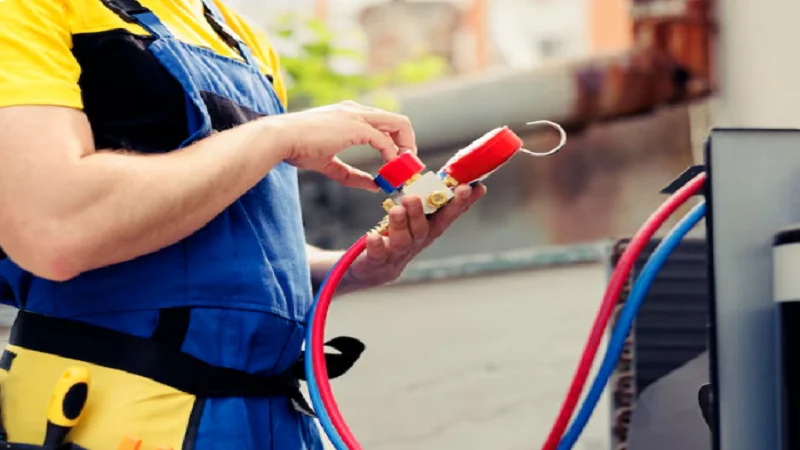
An air conditioner can run for long stretches, keep the fan running, and still fail to cool a space as occupants expect. Rooms stay warmer than they should, humidity lingers, and the thermostat keeps calling for more work without much improvement. In many of these cases, the issue is not immediately visible at the air handler or outdoor unit. Restrictions in the refrigerant lines can quietly interfere with pressure relationships and heat transfer across the system. Once flow is disrupted, cooling performance begins to suffer in ways that can resemble several other faults, which is why understanding line restrictions is important in accurate system evaluation.
What Restricted Flow Changes
- Why Line Restrictions Disturb System Balance
Refrigerant lines are meant to carry a controlled flow between the indoor and outdoor sections of the cooling system, allowing heat to be absorbed indoors and released outside in a steady cycle. When a restriction develops, that movement becomes uneven, and the system starts operating under conditions it was not meant to sustain. Restrictions may come from a kinked line, internal contamination, oil trapping, a partially blocked filter drier, crushed tubing, or debris left behind after earlier repair work. As refrigerant struggles to pass through a narrowed section, pressure conditions shift on both sides of the blockage. One part of the system may be starved while another experiences an abnormal buildup, and that imbalance directly affects how much heat can be transferred. The result is often reduced cooling capacity, longer runtimes, and outlet air that feels less effective even though the equipment is still operating. A restriction also makes diagnosis tricky because the system may still produce some cooling, just not enough to match the load. That partial performance can delay attention while strain quietly increases inside the system.
- Evaporator Starvation Reduces Indoor Comfort
One of the most noticeable effects of a refrigerant line restriction is evaporator starvation. When the indoor coil does not receive the proper amount of refrigerant, it cannot absorb heat as effectively from the return air moving across it. That means the air leaving the vents may feel somewhat cool but not consistently cold enough to lower the room temperature at the normal pace. Humidity removal can also suffer, leaving the indoor environment feeling sticky even when the thermostat is set low. In some cases, the coil temperature may drop unevenly, creating localized icing that worsens airflow problems and adds another layer of confusion to the complaint. A system in this condition often runs longer because the thermostat keeps waiting for a result that the equipment cannot fully deliver. Calls for Air conditioning repair service often begin with complaints about weak cooling. Still, the underlying issue may be a restriction that prevents the refrigerant from feeding the evaporator at the rate needed for stable heat absorption. What seems like a comfort problem in one room can actually trace back to a flow problem hidden in the sealed circuit.
- High-Pressure Stress Can Spread Damage
Restrictions do not only affect the indoor side of the system. They can also cause excessive pressure buildup upstream of the blockage, which places additional stress on the compressor and other components that depend on balanced refrigerant flow. The compressor may be forced to work harder to maintain circulation, and that extra strain can raise operating temperatures, reduce efficiency, and shorten component life over time. If the restriction is severe enough, discharge conditions can become harsh, and oil return may no longer occur in the manner the compressor requires for stable lubrication. This is one reason a cooling system with a restriction may exhibit multiple symptoms at once, including overheating, reduced capacity, nuisance shutdowns, or irregular pressure readings. The outdoor unit may sound normal from a distance, but within the refrigerant circuit, operating conditions can be far from stable. When a blockage distorts pressure-temperature relationships, the system ceases to function as a coordinated whole. Cooling suffers first, but if the restriction is ignored, the mechanical strain can turn a performance issue into a much larger repair.
Small Restrictions Can Cause Large Losses
Cooling systems rely on movement, not just on the presence of refrigerant. Even a partial restriction in the refrigerant lines can interfere with that movement enough to reduce cooling output, weaken humidity control, and place unnecessary stress on major components. The system may continue running, but it will often do so with longer cycles, reduced capacity, and an increasing risk of additional damage. Understanding how restrictions affect the evaporator, compressor, and overall pressure balance helps explain why these faults should be addressed carefully rather than dismissed as minor inefficiency. When refrigerant circulates as the system was designed to handle it, cooling becomes more stable, comfort improves, and the equipment operates under far less strain.