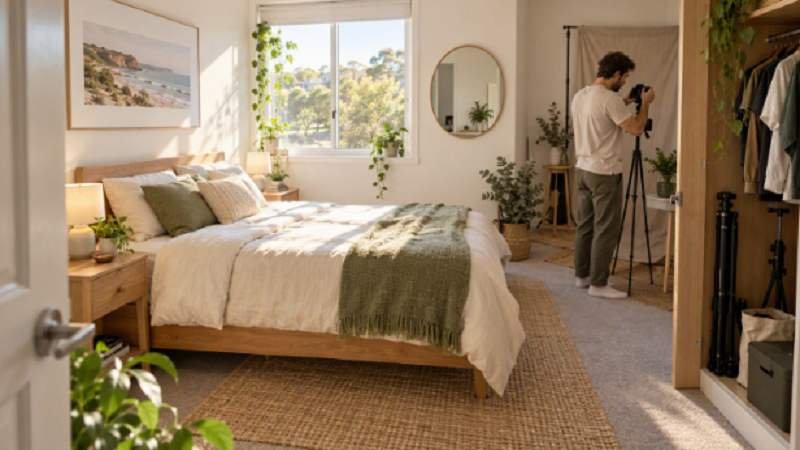
Good feng shui bedroom tips can do two jobs at once: protect a calm sleep zone and create a frame that hides the room’s work clutter. Before moving furniture, use this feng shui bedroom guide as a practical planning resource for bed position, mirror placement, furniture balance, and clear pathways, then test your chosen filming angle at eye level.
Feng Shui Bedroom Tips for a Camera-Ready Sleep Space
Plan the room for life off camera first.
Choose one controlled sightline
Settle the bed and walking route before choosing your filming angle. Put your phone at eye level and inspect only what its lens captures. Limit the frame to one wall or a headboard.
A clean frame doesn’t require an empty room. Leave everyday furniture alone as long as it stays out of the shot and doesn’t block the wardrobe door. Keep door swings and open wardrobes outside the frame. Check for reflective screens and the laundry basket before moving the bed again.
Design a reset that takes minutes
The bedroom still needs to support sleep. Give the tripod and small lights defined storage, with a pouch for their cables. The “studio disappears” test requires storage for every loose piece of equipment, including the folded stand you usually leave beside the bed. Test the reset after recording, then mark the tripod position with removable tape suitable for your floor.
Place the Bed Before You Build the Shot
Feng shui doesn’t require one universal compass direction for every bedroom. Prioritize a solid supporting wall and a view of the main entrance.
The best bed placement in a feng shui bedroom
The command-position convention puts the entrance in view without pointing the foot of the bed directly through it. Keep a usable path around the bed. A camera stand shouldn’t occupy the route to the door.
A feng shui bedroom layout for small rooms
Choose furniture by clearance, not appearance alone. A smaller bed or slim bedside surface can leave more walking space than oversized matching pieces. Fapelli’s space-planning ideas for smaller bedrooms offer context for compact desks and wall-mounted work surfaces. Renters should check permission before drilling into a wall.
Awkward windows and multiple doors
If a window occupies the preferred wall, compare placing the bed beneath it with moving it to a side wall. You may need to surrender your ideal filming background rather than block access to the curtains.
With multiple doors, identify the main entrance first. Keep every door swing clear and angle the camera away from an ensuite or other private adjoining space.
| Room constraint | Bed priority | Camera response | Storage response |
| Small rectangular room | Use a stable wall and preserve the clearest walkway | Frame the headboard or a narrow corner | Use closed vertical storage with a shallow footprint |
| Shared home | Keep the bed away from the busiest doorway where possible | Use a tight frame that excludes common access points | Give filming equipment one lockable or private compartment |
| Window behind the bed | Check drafts, curtain access, and headboard stability | Control backlighting with curtains or a different angle | Keep storage clear of curtain movement |
| Multiple doors | Prioritise the main entrance and keep every door swing clear | Avoid revealing an ensuite or open wardrobe | Use the least visible wall for tall storage |
Control Mirrors and Equipment Inside the Frame
Feng shui bedroom mirror placement
The practical feng shui convention is to avoid placing a mirror directly opposite the bed when you can place it elsewhere. Try a side wall or the inside of a wardrobe door, where it won’t reflect the sleeper.
Check the mirror through the camera for reflections of a light stand or cables. A doorway reflection can expose a private room even if it’s outside the direct shot. Shift the camera before adding decorations to hide the reflection.
Lighting and feng shui bedroom storage ideas
Keep sleep lighting separate. A warm, low-level bedside lamp can stay, but pack away brighter recording lights. No single lamp or color temperature treats a sleep problem.
Treat furniture arrangement as a circulation exercise. Keep access between your bed and the main door clear, with a clear path to the wardrobe. Use closed drawers or boxes to contain visually busy equipment. Keep frequently used pieces near the filming position.
Under-bed storage works best when it’s contained and accessible, not loose around the edges. Push each box fully underneath. Nothing should protrude into your nighttime route.
Protect Sleep Quality Beyond What the Camera Sees
Ventilation belongs in the layout plan
Bedroom ventilation deserves space, even when the camera can’t see it. A 2025 review by Fan and colleagues concluded that bedroom carbon-dioxide concentrations should stay below 1,000 ppm, preferably below 800 ppm, to reduce the risk of disturbed or poorer-quality sleep. Keep an operable window or ventilation point clear of tall cabinets or backdrops.
A 2022 study involving 61 participants was conducted. The study, archived in UNC Charlotte’s repository, associated higher bedroom carbon dioxide levels with poorer objective and self-reported sleep quality, as well as reduced working-memory performance. That’s an association, not a guarantee that moving furniture will change sleep or memory. Leave space to reach the window latch.
Ventilate when the weather and outdoor air allow, without compromising security or ignoring household noise. An open door may be impractical in a shared home, so don’t plan a setup that depends on leaving it open. Test whether the camera setup obstructs the room’s window or door.
Color and Water: Common Feng Shui Questions
Is green suitable for a bedroom?
Yes, especially muted sage or grey-green rather than highly saturated green. As a practical feng shui choice, a subdued shade can look less dominant beside skin tones on camera. Test a sample under daylight and your recording lights.
Is any bedroom color universally lucky?
No bedroom color is universally lucky. Feng shui schools and personal systems attach different meanings to color. Choose a palette you find restful rather than chasing a promised outcome. Repeat a quiet shade in bedding or curtains.
Which colors should you avoid?
No color needs an outright ban. Limit large areas of bright red or neon if they feel stimulating or cast distracting colors onto your face. Busy, high-contrast patterns can also pull attention away from your face. A bright cushion can stay.
Do water features belong in a bedroom?
Skip active fountains and aquariums in a bedroom intended for quiet sleep and simple filming. The equipment also needs maintenance. Moving reflections can intrude on video, and a pump’s hum can linger even after you switch off your microphone. Blue paint or artwork is decorative color, not literal water.
Bad bedroom feng shui starts with blocked movement. Other concerns include a bed exposed to busy doors, a mirror facing the sleeper, or clutter abandoned on the bedroom floor.
Let the Room Return to Rest
You shouldn’t have to negotiate with a studio whenever you want to go to bed. A stable bed position gives the room its everyday purpose, while one intentional sightline limits how much needs to change for a recording. Equipment that fits into its storage doesn’t need a permanent place beside your pillow. After the final take, store the camera and clear the pathway so the room looks complete without the recording setup. See more